Meditation as Part of the Yoga Process
In the previous post I wrote about dyana, or meditation, as a part of the astanga-yoga system. However, just as many people are practicing asanas without practicing, or even knowing about, astanga-yoga, millions are also practicing some form of dyana – meditation.
Meditation has also become very popular in the West, and it takes many forms. One of the most popular is called Mindfulness, and it employs meditation practices as a means of becoming more mindful, aware, or conscious, of one’s world and life. Although today meditation is offered to reduce stress, become more focused and in the moment, and in general, as a way of enhancing the material aspects of one’s life, its original and highest purpose is to make a connection with the divine.
This is accomplished by first learning to bring the mind under control, and then focusing it on the transcendental form of the Lord for prolonged periods of time. Many people think that that spiritual must be the opposite of material, and therefore since we have form the Lord must be formless. This is reasoning that does not understand transcendence. The Lord has a form, but not a material form such as we have. It is a transcendental spiritual form with wonderful transcendental qualities. Neither is the form of the Lord imaginary, nor a mental concoction of whatever we wish it to be, but a very specific form described in the Vedic literature.
There is a wonderful story in the Srimad-Bhagavatam of one person’s successful practice of astanga-yoga and his meditation on the Lord to achieve His darshan. It is the story of the great rajarshi (saintly king) Dhruva, who lived long, long ago in a previous age known as dvapara-yuga. This anecdote is taken from the 4th Canto of the Srimad-Bhagavatam:
Seeing Dhruva’s determination to achieve the audience of the Supreme Lord, his spiritual master Narada Muni instructed him as follows: My dear boy, I wish all good fortune for you. To achieve your desired goal make your residence on the bank of the Yamuna River, in the forest of Madhuvana. By going to that holy place, one draws nearer to the Supreme Personality of Godhead, who always lives there. The waters of the Yamuna are very auspicious, sacred and clear, and you should bathe there three times daily. After bathing, perform the necessary regulative principles for astanga-yoga and then sit down on your asana [sitting place] in a calm and quiet position.
After sitting practice the three kinds of breathing exercises, and thus gradually control the life air, the mind and the senses. Free yourself completely from all material contamination, and with great patience begin to meditate on the Supreme Lord Vishnu.
The form of the Lord is described thus: The Lord’s face is perpetually very beautiful and pleasing in attitude. To the devotees who see Him, He always appears happy and blissful, and He is always prepared to award benedictions to them. His eyes, His nicely decorated eyebrows, His raised nose and His broad forehead are all very beautiful. His beauty is beyond compare with anyone of this material world.
The Lord’s form is always youthful. Every limb and every part of His body is properly formed, free from defect. His eyes and lips are pinkish like the rising sun. He is always prepared to give shelter to the surrendered soul, and anyone so fortunate as to look upon Him feels all satisfaction. The Lord is always worthy to be the master of the surrendered soul, for He is the ocean of mercy.
The Lord is a person, He wears a garland of flowers, and He is eternally manifest with four hands, which hold a conchshell, chakra, club and lotus flower. The Lord bears the mark of shrivatsa, or the sitting place of the goddess of fortune, and His bodily hue is deep bluish.
The entire body of the Supreme Personality of Godhead is decorated. He wears a valuable jeweled crown, necklaces and bracelets, and around His neck is the Kaustubha jewel. He is dressed in yellow silk garments, decorated with small golden bells around His waist, and His lotus feet are decorated with golden ankle bells. All His bodily features are very attractive and pleasing to the eyes. He is always peaceful, calm and quiet and very pleasing to the eyes and the mind.
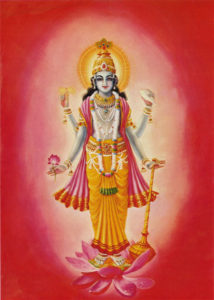
Real yogis meditate upon the transcendental form of the Lord as He stands on the whorl of the lotus in their hearts, the jewel-like nails of His lotus feet glittering. The Lord is always smiling, and the devotee should constantly see the Lord in this form, as He looks very mercifully toward the devotee. In this way the meditator should look toward the Supreme Personality of Godhead, the bestower of all benedictions. One who meditates in this way, concentrating his mind upon the always auspicious form of the Lord, is very soon freed from all material contamination, and he does not come down from meditation upon the Lord.
O son of the King, now I shall speak unto you the mantra which is to be chanted with this process of meditation:
Om namo bhagavate vasudevaya
My dear Dhruva, besides worshiping the Deity and chanting the mantra three times a day, you should meditate upon the transcendental activities of the Supreme Personality of Godhead in His different incarnations, as exhibited by His supreme will and personal potencies.
Follow in the footsteps of previous devotees regarding how to worship the Supreme Lord with the prescribed paraphernalia, or offer worship within the heart by reciting the mantra to the Personality of Godhead, who is non-different from the mantra.
Anyone who engages in the devotional service of the Lord, seriously and sincerely, with his mind, words and body, and who is fixed in the activities of the prescribed devotional methods, is blessed by the Lord according to his desire.
Dhruva did as directed by his spiritual master. Meditating in this way while at the same time increasing his austerities by first eating only dry leaves and grass once every six days, and by practicing pranayama gradually he took one breath only every twelve days. All the while he meditated on the form of the Lord and chanted the mantra given to him by his spiritual master. By successfully following this process of astanga-yoga Dhruva quickly achieved his desired goal to see the Supreme Lord.
As mentioned, the astanga-yoga process is not recommended for this age because who among us can eat only dry leaves or take one breath in twelve days? Fortunately the process of self-realization is adjusted to be suitable for us in our time. In this age the process of self-realization is simply mantra meditation, and the recommended mantra is the Hare Krishna maha-mantra. We need not perform extreme austerities, or live in the forest. We may continue in our way of life as we are accustomed, and achieve the same success as Dhruva Maharaja. Simply by daily meditation on the maha-mantra we will experience the symptoms of genuine spiritual progress becoming manifest within us.
Maha means the greatest, so this maha-mantra is considered the greatest of all mantras:
Hare Krishna, Hare Krishna, Krishna Krishna, Hare Hare
Hare Rama, Hare Rama, Rama Rama, Hare Hare
The glories of the maha-mantra will be further explained in future posts.
As a reminder, if you have any questions please email to spiritualsciencequestions@gmail.com
Recent Comments