Who is God?
In an earlier post we have discussed some of the features about God as the Absolute Truth, explaining how all dualities are reconciled within Him. We have also discussed the Universal Form of the Lord here and here. In this post we are going to explain more features of the Lord, one of which may be accepted by some Westerners, but perhaps without their knowing of the other aspects. Since we are all part and parcel of God we can actually understand quite a bit about God by considering our own nature.
None of us are simply one-dimensional. We all have different aspects of self that are displayed in certain circumstances and relationships. Say for example that we are a college professor. We have our area of specialized knowledge that we share with colleagues, we also have relationships with co-workers, with our spouse, with our parents and siblings, with our children, as well as many purely social relationships. And although all of these different people know us differently we are nonetheless the same person.
In another example, a man may own a company with many employees. He may instruct one of his managers to carry out a particular task, and the managers will in turn instruct the employees. In one sense it is the owner who is directing the employees, although he is not personally present. It is understood that the order is the impersonal aspect of the owner. In another instance he may personally visit the factory and directly give instructions. So the owner has both personal and impersonal aspects. And because the entire enterprise was established by him, his energy is felt throughout the enterprise, and this may be considered his all-pervading presence.
A somewhat well-known, albeit earlier, example of this is the Hewlitt-Packard electronics company. In 1989, one of the founders, David Packard, put the company’s value’s in writing and disseminated it throughout the company. This came to be known as “The Hewlitt-Packard Way.” The HP Way established the culture and served as criteria for daily decision making and management in all areas of the company. As a result of this dedication to stated values the firm became one of the best companies to work for in America. Through the HP Way David Packard’s presence was felt throughout the organization, even if he was not personally present. Naturally if human beings can expand their presence throughout their creation, the Supreme Lord can as well, and He does.
These different aspects of the Lord are described early in the Srimad-Bhagavatam:
vadanti tat tattva-vidas tattvam yaj jnanam advayam
brahmeti paramatmeti bhagavan iti sabdyate
Learned transcendentalists who know the Absolute Truth call this non-dual substance Brahman, Paramatma or Bhagavan.
Westerners know all three of these aspects of God, but not by these names of course.
Bhagavan refers to the person, the supreme person, who is the controller of everything, and who possesses all opulence – wealth, strength, knowledge, beauty, fame, yet at the same time He is not attached to, nor controlled by, this opulence, and He thus possesses the opulence of renounciation. Since all of this world is generated by Him it is His legitimate possession, and is under His total control. Bhagavan is the Supreme God referred to in the Judeo-Christian religions.
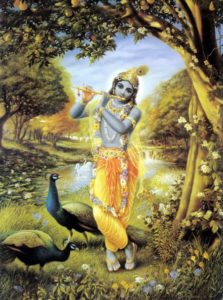
Bhagavan Sri Krishna
Because I am transcendental, beyond both the fallible and the infallible, and because I am the greatest, I am celebrated both in the world and in the Vedas as that Supreme Person.
Bhagavad-gita 15.18
Brahman refers to the impersonal feature of the absolute. Brahman is also called the brahmajyoti, which is the all-pervading “white light” that some yogis aspire to merge into. Within the Brahman there is no differentiation, no distinctions. Everything is a homogenous oneness, a state of complete unity. Some who think of spirit as being the opposite of matter consider Brahman to be Supreme. It is the nirvana of the Buddhists, the Spiritual Sky, the infinite white light, where individual existence is lost in the impersonal. The impersonal Brahman is considered the highest state of bliss by the yogis, and it is the goal of many transcendentalists to enter, or merge into, this impersonal aspect of the Supreme Lord.
The Paramatma or Supersoul, is the all-pervading feature of the Supreme Lord, by which He is personally present throughout His entire creation – within the heart of every living being, as well as within every atom. Although present everywhere the Supersoul is not divided, but is the One that is within the many. The yogis meditate in seclusion on the Supersoul as the Lord in the heart, and aspire to achieve His service. The Supersoul is the Lord within, He is the source of our inspiration, He is our conscience that guides us, and the wee small voice within. The Catholic Church’s concept of the Holy Ghost is also the same idea as the Paramatma.
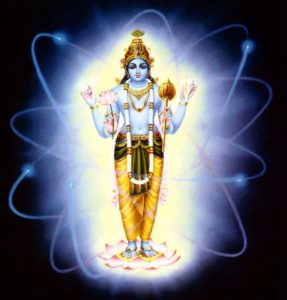
The Vedas teach that we can know God in any of these features, and the choice is up to us. Just as any ordinary person has different relationships – some formal according to their position, and others informal, more close and personal, say family ties – we can also have different relationships with God. There are of course many different elements that go into each relationship, but there is no right or wrong here, and each of us may choose the relationship that we prefer.
While some religions insist that God can only be portrayed in one way only, a more careful analysis indicates otherwise. God is no less a person than ourselves, and thus He is also a complex personality. How we choose to know Him is our decision – but we should know about the various features of God to determine which relationship most appeals to us. Unfortunately, not understanding this science of God as is taught in the Vedas many people simply dismiss the concept of God altogether.
Beyond the three features of God as Bhagavan, Paramatma and Brahman, there are different ways in which God manifests in this material world. These are called avatars. The word ‘avatar’ means “one who descends,” and in each case the Lord ‘descends’ to the earth from the spiritual world. Among the avatars are: lila avatars, guna avatars and shyaktyavesh avatars, and there are many incarnations in each of these categories. In each incarnation the Lord endeavors to attract the conditioned souls of this world to His pastimes and thus to ultimately develop a personal relationship with Him in an eternal personal relationship in the spiritual world.
That is the point of the Spiritual Science – to know God. At the same time this is also the science of knowing oneself or self-realization, since self-realization and God-realization go hand in hand.
Recent Comments